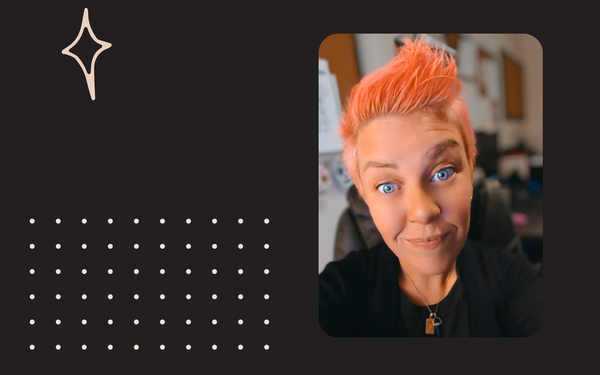
Turning Setbacks into Strategy: Cristin Padgett’s Path to Leadership in Cybersecurity and Tech


When a personal ransomware attack encrypted 150,000 of her photos, Cristin Padgett didn't just pay the ransom — she dove deep into understanding cybersecurity, ultimately launching a career that would span AI, tech, and cybersecurity leadership roles. Now a Customer Marketing & Program Architect at Palo Alto Networks with an Executive MBA from Quantic, Cristin has built scalable programs that generate massive pipeline results and reduce support costs by double digits.
In this candid conversation, she shares how she turned a cyber attack into career fuel, her data-driven approach to building programs that scale across 20,000+ customers, and what it really takes for women to establish credibility and advance in male-dominated tech industries. From translating technical complexity into customer value to pursuing executive education while excelling in demanding roles, Cristin's story offers practical insights for any woman looking to build authority and drive results in the technology sector.
Question 1: Breaking Into Cybersecurity Leadership
With 13 years of successful enterprise experience, you've built a career in the male-dominated cybersecurity and tech industry. What drew you to cybersecurity initially, and what challenges did you face as a woman establishing yourself in this field? How did you navigate building credibility and advancing into technical leadership roles?
A: I was introduced to cybersecurity in one of the most unexpected and personal ways — through a ransomware attack on a personal cloud I had set up to save on cloud storage costs. Overnight, every single one of my photos was encrypted, with attackers demanding $500 in Bitcoin. While the amount wasn’t staggering, the principle was clear: never pay a ransom.
That experience sparked a deep curiosity. I dove into researching how ransomware works, how data can be decrypted, and what it takes to protect digital assets. Eventually, I connected with a firm that specialized in ransomware recovery. They helped me decrypt more than 150,000 of my photos — and later hired me as a GTM consultant to help expand their market share in the U.S.
Breaking into a male-dominated industry wasn’t without challenges. Early on, credibility wasn’t given — it had to be earned. I learned to navigate this by combining storytelling with technical depth, showing not just what cybersecurity solutions could do, but why they mattered in the bigger picture of protecting organizations. Over time, that approach opened doors into the industry where I could influence both strategy and execution for go-to-market programs at scale.
Question 2: Building Scalable Programs
You’ve led large-scale, cross-functional programs at the intersection of marketing, product, and customer success. How do you approach building scalable programs that deliver measurable outcomes?
A: For me, data isn’t just a buzzword — it’s the foundation for building scalable programs. I start by looking at where friction exists: Are customers stalling in the sales cycle? Are large volumes of support cases tied to a single issue? Is pipeline falling short of forecast? Each of these signals points to a different problem to solve.
My strength is connecting those insights to action. I design customer-centric programs that address the root cause, whether that’s enablement, lifecycle engagement, or cross-functional process change. Storytelling and clear messaging are always at the core — they ensure technical complexity is translated into value customers can understand and act on. The result is programs that not only scale but deliver measurable outcomes in adoption, retention, and revenue impact.
For example, at Palo Alto Networks I built a digital adoption program that scaled across 20,000+ customers and 100,000 firewalls. By analyzing TAC case trends, I designed targeted enablement and messaging that directly reduced support cases while accelerating upgrades. The result was measurable impact: 12% YOY lower support costs, 50% higher adoption, and stronger customer trust at scale.
Question 3: Pursuing an Executive MBA While Excelling in Tech
You recently completed your Executive MBA at Quantic School of Business and Technology while maintaining your demanding role at an AI tech startup — Uniphore. What motivated you to pursue advanced business education at this stage of your career? How do you balance continuous learning with the demands of marketing and GTM program management, and what advice would you give to other women in tech about investing in their professional development?
The glass ceiling is real. An MIT Sloan study found that women consistently received higher performance ratings than men — but 8.3% lower ratings on potential. The takeaway? Women are rarely promoted for what they might achieve; we’re advanced for what we’ve already proven.
For me, pursuing an Executive MBA was about closing that gap. I wanted a seal of credibility that demonstrated not only my track record, but also my formal training in business acumen, leadership, and strategic decision-making. The program gave me the frameworks and tools to lead at scale with refined judgment and broader perspective — and Quantic’s global alumni network exposed me to diverse viewpoints that even traditional programs sometimes lack.
One of the ways I’ve applied that learning is through Yes, And Enablement, a company I founded that uses improv-based training to strengthen sales enablement, leadership, and team collaboration. It’s been a powerful proving ground for testing the business frameworks I studied, blending creativity with data-driven outcomes.
Balancing it with a demanding role in tech wasn’t easy. It required ruthless prioritization, carving out learning time just like I would for a board meeting. My advice to other women in tech is this: don’t wait for someone else to validate your potential. Invest in yourself, build the credentials (certifications work too), the personal branding, and build a network to surround yourself with peers who challenge and elevate you. That’s how you create momentum that no bias can slow down.
Are you a woman leader with an inspiring journey to tell? Founded by Women is on a mission to elevate and amplify the voices of women making an impact.
If you're breaking barriers, driving change, or paving the way for others, we’d love to feature your story. Get in touch with us today!
👉 hi@foundedbywomen.org