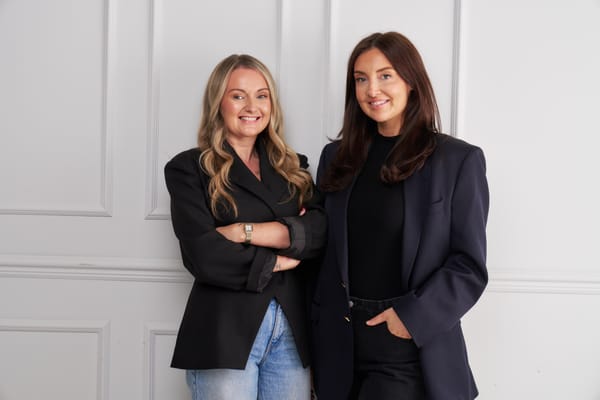
From Recruiter to Marketing Maverick: Jayde Pope on Building Magenta MAD Through Fundamentals, Referrals, and Marketing That's "Anything But Ordinary"


Jayde Pope didn't follow the traditional path to founding a marketing agency. After spending a decade in the trenches of recruitment and estate agency, she launched Magenta MAD—a full-service creative agency that exclusively serves the property and recruitment industries. Known as "The MAD Hatter," Jayde has built a thriving business on marketing fundamentals over fads, with around 90% of her clients finding her through referrals and word-of-mouth recommendations.
From freelancer to full-service agency in less than a year, Magenta MAD has generated over £5 million in revenue for SMEs, delivered 4 million+ social media impressions, and executed over 4,100 email campaigns. Jayde's approach is unapologetically direct: she calls out ineffective marketing, champions consistency over "shiny new tactics," and believes that great marketing starts with clear messaging, proof, and strategic fundamentals—not just flashy campaigns.
In this Q&A, Jayde shares her insights on building a referral-based agency, the importance of treating employees with respect to create a team that genuinely cares, and why female founders should master the marketing basics before chasing the latest trend. Her advice is practical, honest, and delivered with the kind of clarity that comes from someone who's been on both sides of the table.
From Recruiter to Marketing Agency Owner - Building Magenta MAD
You founded Magenta MAD after working in recruitment, creating a specialized marketing and branding agency focused exclusively on the property and recruitment industries. You've positioned yourself as the "MAD Hatter" who helps businesses change perceptions through marketing that's "anything but ordinary." For female founders who are considering leaving stable careers to start niche agencies, what made you confident enough to specialize so narrowly (property and recruitment only)? How did your recruitment background inform the way you approach marketing for these industries differently than generalist agencies? What surprised you most about the transition from being in the industry to serving it?
My confidence in niching down came from two places: firstly, I know estate agency and recruitment inside-out. I spent a decade in the trenches of both industries, seeing what works, what absolutely doesn’t, and where businesses repeatedly trip over the same problems. Secondly, in marketing you quickly learn that the more niche you go, the sharper your message becomes. Broad strokes don’t convert. Precision does.
My recruitment/estate agency backgrounds give me something generalist agencies simply can’t replicate - context. I don’t have to guess how a valuer thinks before a market appraisal, or what keeps a recruitment agency owner awake at 3am. I’ve lived it. That means the strategies I build aren’t hypothetical; they’re rooted in real motivations, pressures, objections, and bottlenecks. It also means I can communicate with their clients and candidates in language that actually resonates, not in generic “industry speak.”
What surprised me the most about the transition was how undervalued marketing still is in the UK. My US clients tend to understand that marketing is an engine, not decoration, and they see the relationship between long-term consistency and long-term revenue. In the UK, marketing can still be treated like a nice-to-have or something fluffy that sits on top of the “real work.” Yet those same businesses panic when leads dry up. There’s an education gap that I didn’t anticipate when I started Magenta MAD, but it’s one I’m very comfortable filling… with a megaphone, when required.
Building a Referral-Based Agency - 90% Word of Mouth Growth
You've said around 90% of your clients find Magenta MAD "the old-fashioned way, by being told to" after seeing the work and hearing rave reviews. In an industry where agencies typically rely on paid ads and cold outreach, how did you build a business where clients come pre-sold through referrals? For female entrepreneurs in creative services or B2B consulting, what's your framework for creating work that people can't help but recommend? How do you balance being "good at what you do" with being "good to work with" in ways that actually drive word-of-mouth growth?
I spent 10 years working in the exact industries I now serve, building relationships, helping people, showing up, and proving myself. So when I shifted into marketing, I already had a community watching. They saw I wasn’t just “starting an agency”. I was genuinely improving businesses they knew. My first clients were people who’d followed my journey and thought, “If she’s doing this for others now, we want in.” And once the wins started stacking up, referrals snowballed.
There’s no big secret to it, really. Be the person you’d want working on your business. Do the little things others overlook. Communicate well. Fix problems fast. Show appreciation loudly. I’ve taken clients out for lunch, sent Christmas gifts to their whole teams, checked in when I didn’t “need” to - and I’ve done that long before I had any real financial room to do it. It matters. People remember how you treat them as much as the results you deliver.
The balance between being good at what you do and being good to work with is something I’m still working on! I’m a recovering perfectionist, so handing work to employees or freelancers used to feel like handing over my firstborn. But you can’t build an agency where clients love you and the work unless you let your team shine too. I believe it also comes down to how you treat your employees and have always said I want to be a safe haven for creatives, where they are free to be adventurous, are treated like adults and treated with respect.
So I guess the real balance is this: set your standards high, train and treat people well, and then back off enough for them to execute, but still be there for them when needed. In my experience, this has created a team that appears to care as much about my business as I do. And clients can feel when your whole team cares, not just you.
The Fundamentals vs. The Shiny - SEO, Tactics, and Cutting Through Marketing Noise
You've been vocal on LinkedIn about how marketing fundamentals remain constant even as tactics evolve, comparing modern SEO to businesses naming themselves "AAA Garage" in Yellow Pages to rank first. You've also called out agencies running ineffective campaigns (poor graphics, unused Shopify catalogues, massive ad spend with terrible ROI). For female founders trying to build visibility on limited budgets, how do they distinguish between fundamental marketing principles that work versus chasing "something completely new and shiny"? What are the non-negotiable marketing basics that startups should nail before worrying about the latest platform or trend? How should founders audit whether their current marketing is actually set up to succeed?
I’ve always worked with businesses on limited budgets, so I understand the pressure to make every pound count. Yes, marketing includes trial and error (that’s literally part of the science) but small businesses don’t have the luxury of throwing money at random tactics and hoping one sticks. That’s why the fundamentals matter more than the fads.
The non-negotiable basics every founder should nail before touching anything “new and shiny” are:
1. A clear value proposition.
If you can’t explain why someone should choose you over a competitor in one sentence, no amount of SEO or TikTok hooks will save you.
2. A website that actually converts.
Not just “pretty.” Clear. Fast. Easy to navigate. Built for humans and Google equally. CTAs in the right places. Mobile-first (because everyone is scrolling on the loo).
3. Messaging that speaks to pain, not features.
People buy outcomes and relief. Not buttons, colours, or job titles.
4. Consistency.
You can’t post three times in March and then panic in August. Visibility compounds. Silence kills momentum.
5. Proof.
Testimonials, case studies, screenshots, numbers…if the internet is one giant shouting match, proof is your megaphone.
Once those foundations are set, you can layer in tactics. But without them? You’re just decorating a house with no foundations.
As for auditing your current marketing, ask three brutally honest questions:
- Is it clear what I offer and who it’s for within three seconds of seeing my website or LinkedIn?
- Is anyone actually converting or are we confusing “activity” with “progress”?
- If I stopped posting tomorrow, would anyone notice, and would they miss the value I create?
If you can’t answer yes to all three, you don’t need something shiny. You need the basics to work harder.
Are you a woman leader with an inspiring journey to tell? Founded by Women is on a mission to elevate and amplify the voices of women making an impact.
If you're breaking barriers, driving change, or paving the way for others, we’d love to feature your story. Get in touch with us today!
👉 hi@foundedbywomen.org